AI Fleet Copilots Are Here. Who Computes the Numbers?

In one week, three telematics and fleet management vendors announced conversational AI assistants: Ctrack launched DOT for its Crystal platform, Webfleet previewed an LLM-based Advisor Tool at IAA Transportation 2026, and Fleetworthy introduced RADAR inside its toll management product. The race to wrap fleet data in a chat interface is on. But for carriers evaluating these tools, the critical question is not whether an AI can answer questions. It is whether you can trust the numbers behind the answer.
The week that AI copilots arrived
On November 10, Ctrack announced DOT, an AI-powered assistant designed to help fleet managers navigate its Crystal telematics platform. Steve Thomas, UK managing director at Ctrack, framed the problem directly: "One of the biggest criticisms of telematics over the years is around the amount of data being generated, with fleets not having resources to convert this information into decisions." DOT is positioned as the first step in an intelligent fleet management rollout, with plans for results-based analysis and data-driven insights over the coming months.
A few days earlier, at IAA Transportation 2026, Webfleet previewed its AI Advisor Tool. Michiel Ooms, Webfleet's VP of Value Proposition Management, explained that the Advisor Tool is based on a large language model, used by Webfleet under licence and trained only on data provided by Webfleet. The model combines vehicle data with relevant contextual data to provide insights on fleet behavior and advice on what actions the manager should take. "The point is to enable managers to focus on what actions really matter to their fleets," Ooms said.
The same week, Fleetworthy launched RADAR (Real-time AI, Decisioning and Automated Resolution) inside its toll management product. RADAR allows fleet managers to ask questions about toll activity—why a particular charge appeared, how a transponder is performing, where toll leakage is occurring. The initial focus is toll management, with plans to extend the capability to safety, compliance, and weigh station bypass products in 2027.
The architecture that matters: auditable queries
What separates RADAR from a generic chatbot bolted onto fleet data? According to FreightWaves, the answer is architectural: "The platform uses a commercial large language model to explain results in plain language. However, the AI model does not generate the underlying figures. Those calculations come from defined queries against the customer's Fleetworthy data, which the company said are auditable."
This is a crucial distinction. When a fleet manager asks "What did we spend on tolls last month on the I-95 corridor?", the LLM is not guessing or hallucinating a number. A deterministic query runs against the actual toll transaction data, produces a figure, and the LLM formats the explanation in plain English. If the number is wrong, the issue is in the data or the query logic—both of which can be inspected and corrected. The AI cannot invent a toll charge that does not exist in the records.
Shay Demmons, Fleetworthy's Chief Product Officer, emphasized the human-centered design: "AI from our perspective is we believe we want it to be human centered, meaning it's not a black box." When a response is inaccurate or conflicts with a fleet's records, Fleetworthy recommends contacting its customer support team for assistance. The company views RADAR as something that supports human decision-making, not replaces it.
The data problem these tools cannot solve
A conversational AI layer is a user interface improvement. It does not fix the underlying data fragmentation that still plagues most fleets. The American Transportation Research Institute's September 2026 report, "From Data to Decisions," found that 48% of surveyed carriers do not integrate their telematics data with maintenance management software. Nearly one in three do not connect telematics to their TMS. A SambaSafety survey cited in the same research found that 66% of fleets name interpreting or acting on data as a top telematics challenge.
An AI copilot that sits on top of fragmented data will give fragmented answers. Ask it "What is our cost per mile by lane?" and if fuel-card data, TMS settlements, and maintenance costs live in three separate systems with no governed join, the AI cannot synthesize what does not exist. It can only query what has been connected. The real leverage from these tools emerges only after the underlying data integration work is done.
| Question | Required Data Sources | Integration Challenge |
|---|---|---|
| Cost per mile by truck | TMS, fuel cards, maintenance, tolls | Four systems, often no shared key |
| Fuel efficiency by driver | Telematics, fuel cards, payroll | Driver ID must match across systems |
| Detention cost vs. load revenue | TMS, ELD/telematics | Detention often tracked manually |
| Toll leakage by lane | Tolls, TMS, telematics | Transponder ID tied to unit, not load |
| Maintenance cost by unit vs. revenue | CMMS, TMS, telematics | Work orders rarely tied to loads |
What carriers should ask before trusting an AI copilot
The vendor demos will be impressive. The chatbot will answer questions in natural language. The real due diligence happens before the demo, when you ask how the system actually works. Here is a practical checklist:
- Where do the numbers come from? Is the LLM generating figures, or are defined queries hitting your actual data? If you cannot see the query or the source rows, you cannot audit the answer.
- Can you trace an answer to source records? When the AI says you spent $47,000 on tolls last quarter, can you drill down to the individual transactions that sum to that figure? If not, you are trusting a black box.
- Which systems are joined? If the copilot claims cost-per-mile insights, confirm whether it is pulling from TMS, fuel, maintenance, and tolls—or just one feed labeled as CPM. Partial data produces partial truth.
- Is it your data or industry benchmarks? RADAR explicitly uses only each customer's own data. Other tools may blend proprietary benchmarks, which can obscure variance in your specific operation. Know what baseline is being used.
- Who approves actions? An AI that surfaces an insight is different from an AI that executes a workflow. If the tool recommends changing a driver assignment or approving a charge, confirm that a human sees and approves the action before it takes effect.
These questions separate a productivity tool from a liability. A copilot that explains auditable queries is a force multiplier for a manager. A copilot that hallucinates figures or obscures data sources is a compliance risk.
The integration work that precedes the AI layer
Carriers considering AI copilots should start with data readiness, not vendor selection. The telematics-to-shop gap covered in detail elsewhere on this site is the primary blocker: if your ELD, TMS, CMMS, and fuel-card systems do not feed into a common data layer with consistent definitions, no AI interface can synthesize the answers you need.
The practical sequence is not complicated, but it requires discipline. First, audit what systems you run and which ones export data or offer APIs. Second, define cost per mile with finance and operations—document the inputs and the denominator before you ask an AI to report it. Third, pick one integration to close first: telematics to TMS, or telematics to maintenance. Fourth, build exception lists, not dashboards. The goal is action, not reporting. Fifth, track a single KPI end to end before expanding scope. This sequence produces the data layer an AI copilot can actually leverage.
Why the timing matters for insurance
Underwriters increasingly evaluate carriers on data maturity. A fleet that can show integrated data—scorecards, coaching records, maintenance discipline, CPM control—presents a lower risk profile than one with the same hardware and no process around the data. Fleet analytics directly affect insurance rates, and the ability to explain your numbers at renewal is a competitive advantage.
An AI copilot that produces auditable answers is a renewal asset. It means your safety manager can walk into a meeting with an underwriter and answer questions in real time, backed by data the underwriter can request to verify. A copilot that generates unverifiable insights is the opposite—it creates confidence without evidence, which is exactly what underwriters learn to distrust.
Where FleetOS fits
FleetOS is the governed data layer we build for motor carriers. It connects TMS, telematics, maintenance, fuel, and tolls into a single operating picture, with cost per mile that finance and operations agree on, exception queues that surface problems before dispatch, and export packages for insurance and shipper qualification. When an AI layer sits on top of FleetOS, the answers are auditable because the underlying data is joined, validated, and defined in one place.
The new conversational interfaces from Ctrack, Webfleet, and Fleetworthy are promising developments. They address the real problem of data overload that carriers face. The question is whether your data is ready for the conversation—and whether you can trust the answers you get. That readiness is what FleetOS is designed to deliver.
Conclusion
The arrival of AI copilots in fleet management marks a shift in user experience, from dashboards and reports to natural-language questions and answers. The underlying challenge remains unchanged: the answers are only as good as the data they query. Fleetworthy's explicit separation of LLM explanation from auditable computation is the architecture to look for—it means you can trace an answer, audit the query, and hold the system accountable when something is wrong.
For carriers evaluating these tools, the checklist is straightforward. Know where the numbers come from. Confirm you can trace answers to source rows. Verify which systems are joined. Understand whether you are seeing your own data or blended benchmarks. And ensure that actions require human approval. Get those answers before the demo, and you will know whether the AI copilot is a tool you can trust—or a layer of convenience hiding a data gap you still need to close.
Frequently asked questions
What is the difference between an AI copilot that generates numbers and one that queries data?
An AI that generates numbers uses the LLM to estimate or calculate figures, which introduces the risk of hallucination or error. An AI that queries data uses deterministic, defined queries against your actual records, then uses the LLM only to explain the results in plain language. Fleetworthy's RADAR is an example of the latter architecture—the figures come from auditable queries, not from AI generation.
Why does data integration matter before adopting an AI copilot?
An AI copilot can only query data that has been connected and joined. If your TMS, fuel cards, maintenance system, and telematics live in separate silos, the AI cannot synthesize cost-per-mile by lane or driver. The 48% of fleets that ATRI found do not integrate telematics with maintenance software will get limited value from any AI layer until that integration work is done.
How can I verify that an AI copilot's answers are accurate?
Ask the vendor whether you can trace any answer back to the source rows it summarizes. If the AI says you spent $12,000 on tolls in October, you should be able to drill into the individual transactions. If that audit trail does not exist, you are trusting a black box.
Do AI fleet copilots replace the need for a data team or analyst?
Not yet. These tools reduce the time required to ask common questions, but they do not replace the data engineering work of connecting systems, defining metrics, and validating quality. A copilot is a productivity layer on top of a governed data foundation, not a substitute for building that foundation.
How do AI copilots affect insurance renewals?
Underwriters increasingly evaluate data maturity alongside loss history. A copilot that produces auditable answers—backed by integrated data—allows your team to respond to underwriter questions in real time with verifiable figures. That capability differentiates your operation from carriers who can only provide loss runs and anecdotal process descriptions.
Haseeb Tariq
Co-Founder at Vyntrix Labs
Keep reading
The Telematics-to-Shop Gap: Why Half of Trucking Fleets Still Can't See Real Cost Per Mile
ATRI's 2026 report found trucking has broadly adopted telematics for safety, but nearly half of fleets never connect that data to maintenance software. Here's why the gap matters—and a practical plan to close it.
Haseeb Tariq
Co-Founder
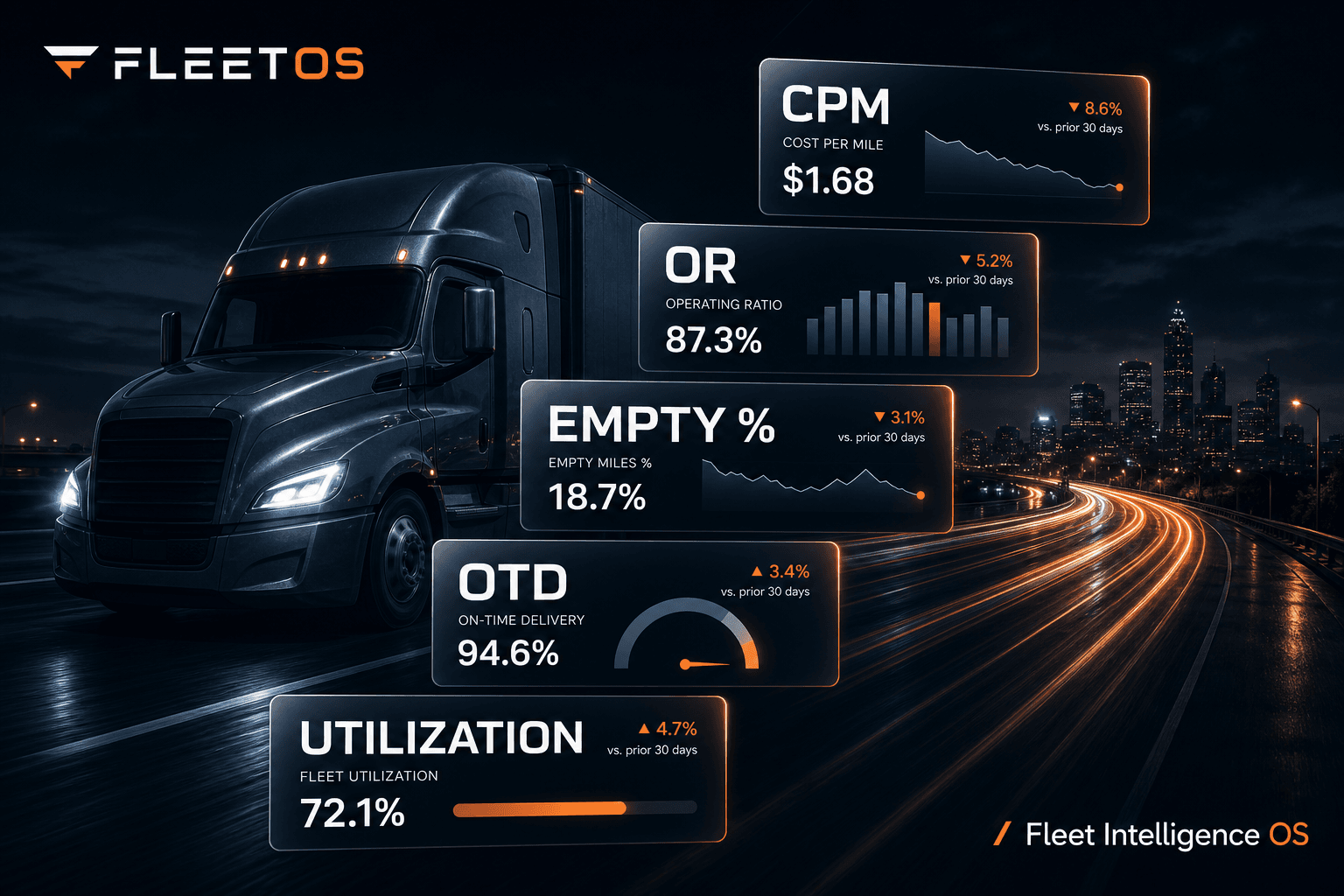
FleetOS: Why Fleet Intelligence Is More Than Dashboards
Motor carriers already own TMS, telematics, and shop systems. FleetOS is the governed decision layer on top, cost-per-mile truth, exception-first ops, and AI that explains what to do next.
Ashir Haroon
CEO
Fleet Analytics for Trucking Carriers: The Data That Now Prices Your Insurance
Carrier-side analytics—TMS, telematics, maintenance, and claims data—is becoming the credit score for insurance rates and shipper qualification. How carriers should turn scorecards, coaching records, and governed CPM data into renewal leverage.
Ashir Haroon
CEO