Telematics Is Now the Baseline for Commercial Trucking Insurance
Through 2024 and into 2025, insurers began asking a different question during trucking policy renewals. It was no longer 'do you have telematics?' but 'what are you doing with the data?' The distinction marks a turning point. Having cameras and ELDs installed is now assumed. The underwriting conversation has moved to whether a carrier can demonstrate a documented safety culture, coaching programs that respond to events, and measurable improvement in risk metrics over time.
This shift changes the economics of fleet technology. A carrier that treats telematics as a compliance checkbox will not receive the same rates as a fleet that integrates event data into weekly coaching, documents interventions, and can show an underwriter how driver scorecards have improved quarter over quarter. Insurance capacity has tightened in the commercial trucking market since 2022, and insurers are using data fluency as a filter.
Why the baseline has moved
Several forces converged to make telematics table stakes rather than a differentiator. First, hardware commoditized. ELD mandates pushed adoption, and camera pricing dropped enough that forward-facing video became practical for small fleets. Second, insurers built internal teams—or partnered with vendors—capable of ingesting and scoring telematics feeds directly. Business Insurance reported in 2025 that leading commercial auto insurers now expect telematics as a baseline requirement for fleet coverage, not a bonus factor.
Third, loss experience in trucking remained elevated. Nuclear verdicts, rising repair costs, and medical inflation kept combined ratios unfavorable. Insurers responded by segmenting risk more aggressively. A carrier with cameras but no coaching is no longer comparable to a carrier with cameras, coaching documentation, and demonstrated safety-metric improvement.
What underwriters ask now
The renewal conversation has expanded beyond loss runs and years in business. Alliant's 2026 Transportation Insurance Outlook highlights that underwriters increasingly request evidence of safety management systems, driver training records, and telematics utilization metrics. Expect questions in these areas:
- What percentage of the fleet is equipped with forward-facing and driver-facing cameras?
- How are critical events (hard braking, following distance, distracted driving) reviewed and documented?
- Is there a formal coaching process when an event occurs, and how is that intervention recorded?
- Can you show driver scorecards and trend lines over the past year?
- What is the average time between an event and the coaching conversation?
- Do drivers sign or acknowledge coaching documentation?
The goal is to distinguish carriers that operate a documented safety culture from those that have the equipment but no process around it. Insurers want to see that the data changes behavior, not just that the data exists.
Documented coaching as an underwriting asset
SambaSafety's 2026 Telematics and Fleet Risk Report found that fleets with formal coaching workflows tied to telematics events experienced lower at-fault accident rates over a three-year window than fleets with similar equipment but ad-hoc review processes. The report emphasizes that coaching must be documented and consistent, not just occasional.
Documentation serves two purposes. During underwriting, it demonstrates process maturity. During a claim—especially litigation—it shows that the carrier did not ignore warning signs. A driver with a history of hard braking events that were never addressed becomes a liability exposure. A driver with the same history, where each event was reviewed, discussed, and acknowledged in writing, represents a very different story in discovery.
Carriers often keep coaching records in a driver file folder or a spreadsheet. The gap is connecting those records to the telematics event that triggered them. If an underwriter or attorney asks 'what happened after the June 14th following-distance alert,' the answer should be a documented coaching conversation with a date, summary, and acknowledgment—not a search through email threads.
Risk scores and renewal leverage
Connected-insurance programs that integrate telematics data into premium calculations have expanded beyond personal auto. FreightWaves covered the Daimler Truck–Geico partnership, which uses connected-truck data to adjust commercial insurance pricing based on real driving behavior, not just historical loss runs. Similar pilots exist with other OEMs and insurers.
For carriers outside those programs, the principle still applies. A fleet that can present an underwriter with a risk scorecard—showing improvement across hard-braking frequency, speeding percentage, and distracted-driving events—has negotiating leverage that a fleet with only loss data does not. The loss run tells you what happened. The scorecard tells you what is likely to happen.
| Data Type | What Underwriters Learn | Carrier Action Required |
|---|---|---|
| Loss runs (traditional) | Historical claim frequency and severity | Submitted via broker; limited carrier influence on presentation |
| Driver scorecards | Current risk profile across measurable behaviors | Export from telematics, show trend over 6–12 months |
| Coaching documentation | Whether events lead to intervention | Link each critical event to a documented coaching record |
| Camera footage review | Context for events, exoneration potential | Demonstrate consistent review process, retention policy |
| CSA / FMCSA scores | Regulatory risk, inspection history | Monitor and remediate BASIC percentiles |
Beyond loss runs: the Samsara Beyond panel insight
At Samsara Beyond 2025, an underwriter panel discussed how their firms evaluate trucking risks. The consensus, reported by Truck News, was that underwriters now look beyond loss runs to telematics utilization, camera footage review practices, and whether coaching programs are integrated into the safety workflow. One panelist noted that two carriers with identical five-year loss histories can receive different quotes if one demonstrates active safety management and the other does not.
The implication for carriers: loss improvement alone is not sufficient. A carrier that had a bad year in 2023 but has since implemented documented coaching, improved driver scorecards, and can present that story coherently may fare better than a carrier with slightly better losses but no evidence of process change.
What carriers should prepare for renewal
Insurance renewals in commercial trucking increasingly resemble due diligence. Carriers should prepare a renewal package that goes beyond the broker submission:
- Equipment summary: percentage of fleet with ELDs, cameras (forward, driver-facing, side), and any ADAS features.
- Utilization metrics: how many events were captured, reviewed, and acted on in the past policy period.
- Coaching documentation: sample reports showing the link between telematics events and driver coaching conversations.
- Scorecard trends: driver-level or fleet-level scorecards with month-over-month or quarter-over-quarter improvement data.
- Safety program overview: written policies for event review, coaching cadence, and driver acknowledgment.
- Training records: certifications, onboarding, and refresher training tied to the behaviors telematics measures.
This package does not guarantee better rates, but it positions the carrier to compete for capacity in a market where underwriters are actively filtering for data maturity.
The role of analytics in insurance positioning
Raw telematics data is not enough. Carriers need to translate events, miles, and scores into a narrative an underwriter can evaluate. This is where fleet analytics platforms add value. A governed data layer—like FleetOS—can consolidate telematics, TMS, maintenance, and safety data into dashboards and exports that present the fleet's risk profile coherently.
The companion post, Fleet Analytics for Trucking Carriers, covers how carriers can build the analytics foundation that supports not only operations but also insurance and shipper qualification. The data that reduces insurance costs is the same data that demonstrates reliability to shippers.
Insurance as a fleet intelligence use case
For carriers already invested in telematics, the insurance opportunity is a matter of process and presentation. The hardware exists. The data exists. What is often missing is the governed workflow that connects an event to a coaching conversation, documents it, and surfaces trend data for external stakeholders.
HaulSure OS, our solution for trucking insurance operations, helps carriers and agencies manage the documentation, scoring, and reporting that underwriters now expect. It sits alongside the TMS and telematics, not as a replacement, but as the layer that makes the data usable for risk management and renewal conversations.
Operational problems that affect insurance outcomes
Insurance positioning is downstream of operational discipline. Carriers struggling with the problems every fleet faces—detention, maintenance, driver communication—often have fragmented data that makes it difficult to present a coherent safety story. When the data lives in separate systems without a common definition, the insurance conversation suffers along with dispatch and billing.
The haul lifecycle also matters. A carrier that captures arrival and departure times, documents accessorials, and closes loads cleanly will have better data hygiene than one that reconstructs facts at month-end. That same discipline produces the documentation insurers want to see.
Conclusion
Commercial trucking insurance underwriting has moved past the telematics adoption question. Insurers assume the equipment exists. The new question is whether carriers can demonstrate a documented safety culture, coaching programs tied to telematics events, and measurable improvement in risk metrics over time. Carriers that treat telematics as a data source for operations, coaching, and renewal leverage will outperform those that treat it as a compliance checkbox. The hardware is the baseline. The process is the differentiator.
Frequently asked questions
Do we still get credit for having telematics installed?
Installation alone is now expected, not rewarded. The credit, where it exists, goes to carriers who can demonstrate utilization: event review, documented coaching, and scorecard improvement. Having cameras is the baseline; using the data is what differentiates.
What documentation should we keep for coaching?
At minimum, record the telematics event that triggered the coaching, the date of the conversation, a summary of what was discussed, and an acknowledgment from the driver. Store these records in a way that allows retrieval by driver, date, or event type. Underwriters and attorneys may ask for them.
How do driver scorecards help with insurance?
Scorecards translate telematics events into a risk metric underwriters can evaluate. A fleet that shows improving scorecards over 6–12 months demonstrates that safety programs are working. Loss runs show the past; scorecards indicate the likely future.
What if our loss history is good but we do not have coaching documentation?
Good loss history still matters, but carriers with similar loss records compete for the same capacity. Documentation of coaching and safety process can be the tiebreaker. It also protects against future claims where plaintiff attorneys may argue the carrier ignored warning signs.
Is driver-facing camera footage required?
Not universally required, but increasingly preferred by insurers. Driver-facing footage provides context for events (was the driver distracted, or did the hard brake result from a pedestrian entering the road?). Carriers that resist driver-facing cameras should weigh the privacy concerns against the underwriting and litigation benefits.
How does this affect small fleets differently than large ones?
Small fleets face the same expectations but may lack dedicated safety staff. The solution is to build a consistent, documented process even if it is simple—a weekly review of critical events, a template for coaching notes, and a file per driver. Scale the process, not the complexity.
Ashir Haroon
CEO at Vyntrix Labs
Keep reading
Fleet Analytics for Trucking Carriers: The Data That Now Prices Your Insurance
Carrier-side analytics—TMS, telematics, maintenance, and claims data—is becoming the credit score for insurance rates and shipper qualification. How carriers should turn scorecards, coaching records, and governed CPM data into renewal leverage.
Ashir Haroon
CEO
Operational Problems Trucking Carriers Still Have to Manage
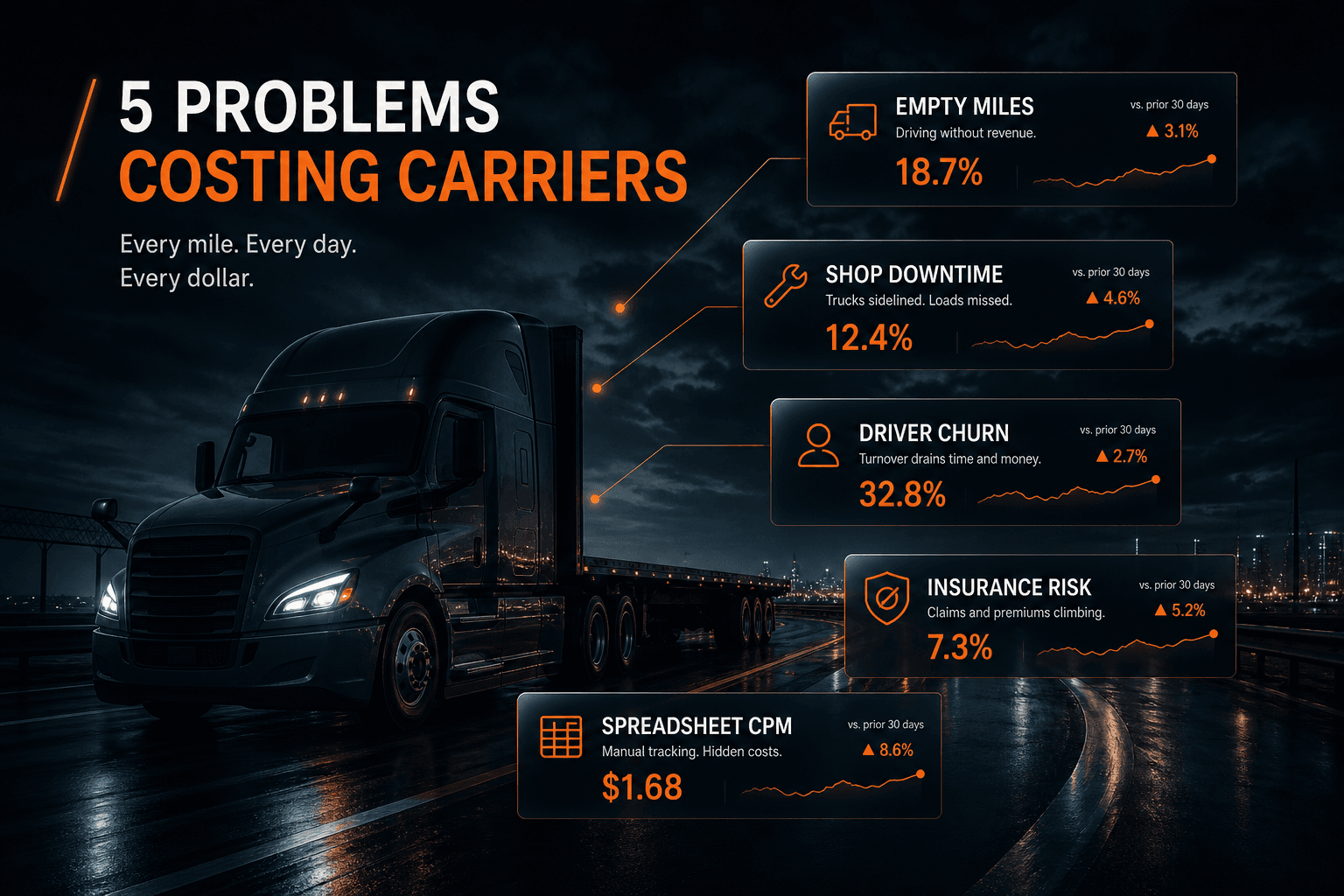
Empty miles, detention, maintenance, dispatch, billing, and fragmented TMS and ELD data, why these carrier problems persist, and where a shared operating picture changes the work.
Sufyan
AI Engineer
How Trucking Carriers Run a Haul, From Tender to Settlement
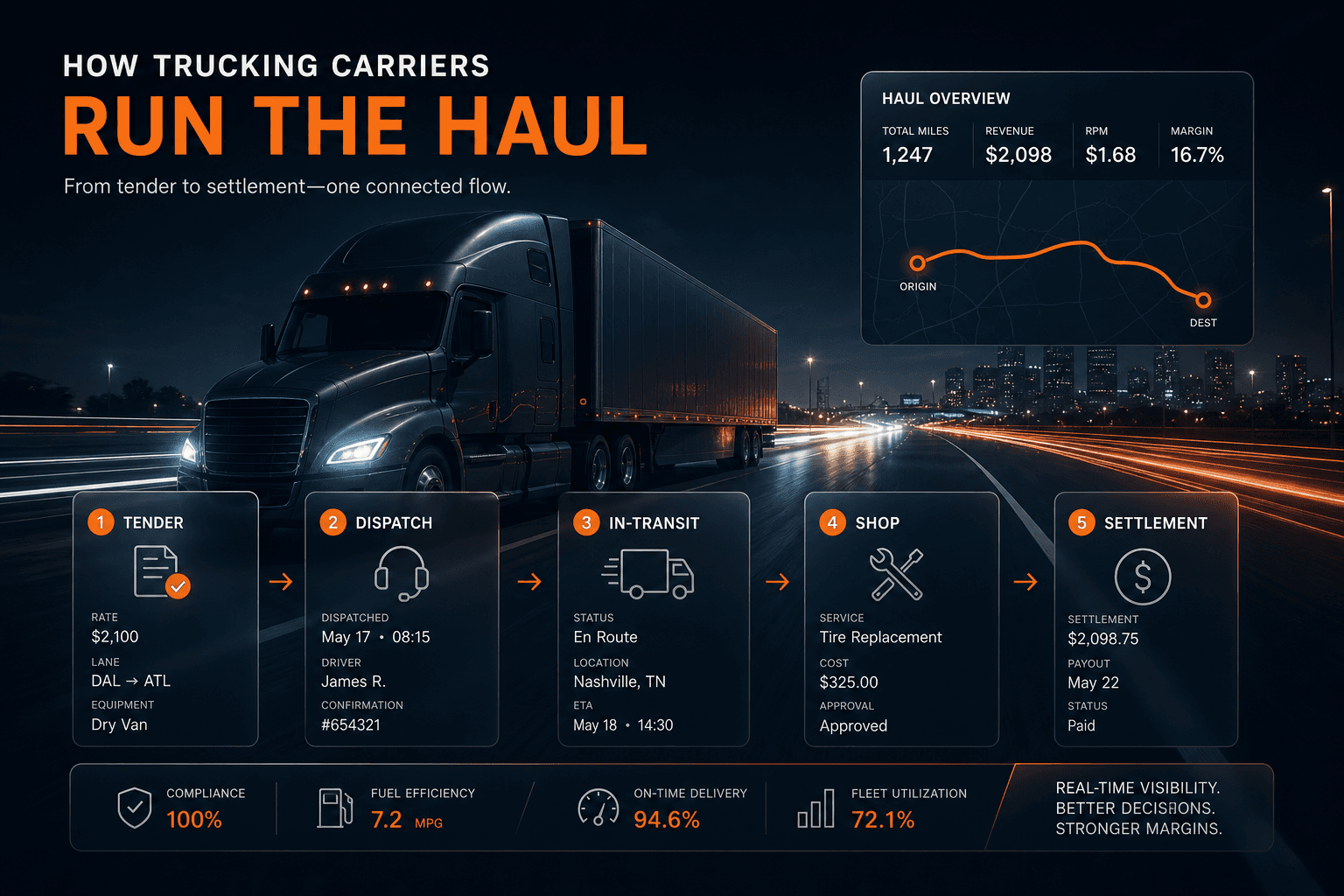
The operational lifecycle of a motor-carrier load (tender, planning, dispatch, pickup, transit, delivery, POD, billing, and settlement) and where the data usually falls out of the chain.
Haseeb Tariq
Co-Founder